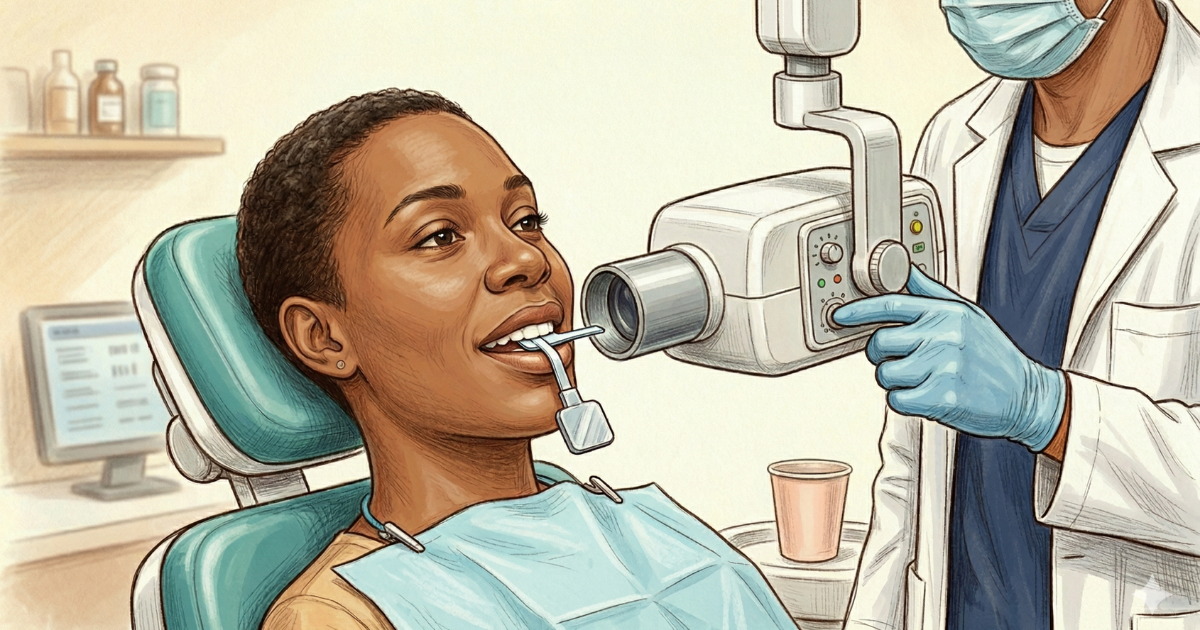
I want to tell you about all the different types of X-rays we take in dentistry.
Because a lot of people take X-rays and don’t really know what we’re looking for — or why we need them.
Each type of X-ray gives us different information, and together, they help us plan your treatment properly and make sure everything is healthy.
The first one is a panoramic X-ray.
This X-ray shows us an overview of all the teeth in one frame.
We usually use this to:
It gives us a big-picture view of everything we need to consider when planning your dental treatment.
The second X-ray is the lateral ceph X-ray.
This one is mainly used for orthodontic treatment planning.
With this X-ray, we look at specific landmarks in the head and neck to help us determine the best possible outcomes for your orthodontic treatment.
It helps us understand how everything is aligned and how your treatment should be approached.
The third X-ray is called the periapical X-ray.
This X-ray helps us see the entire structure of one or two individual teeth — including the apex, which is the tip of the root.
We use this when we want to:
It’s not just about the tooth — it’s about everything around it.
This allows us to properly diagnose what’s going on and give you the best treatment possible.
The final X-ray is the bitewing X-ray.
This is actually the most common X-ray we take, especially during routine dental check-ups.
Bitewing X-rays help us:
They give us a very clear and detailed view in one frame.
Typically, we take between 2 to 4 bitewing X-rays per person during a check-up.
So there you have it — the four most common X-rays we use in dentistry.
Each one serves a different purpose, and together, they give us a complete picture of your oral health.
Because at the end of the day, it’s not just about what we can see on the surface.
It’s about what’s happening underneath — so we can diagnose properly and give you the best care possible.


.svg)