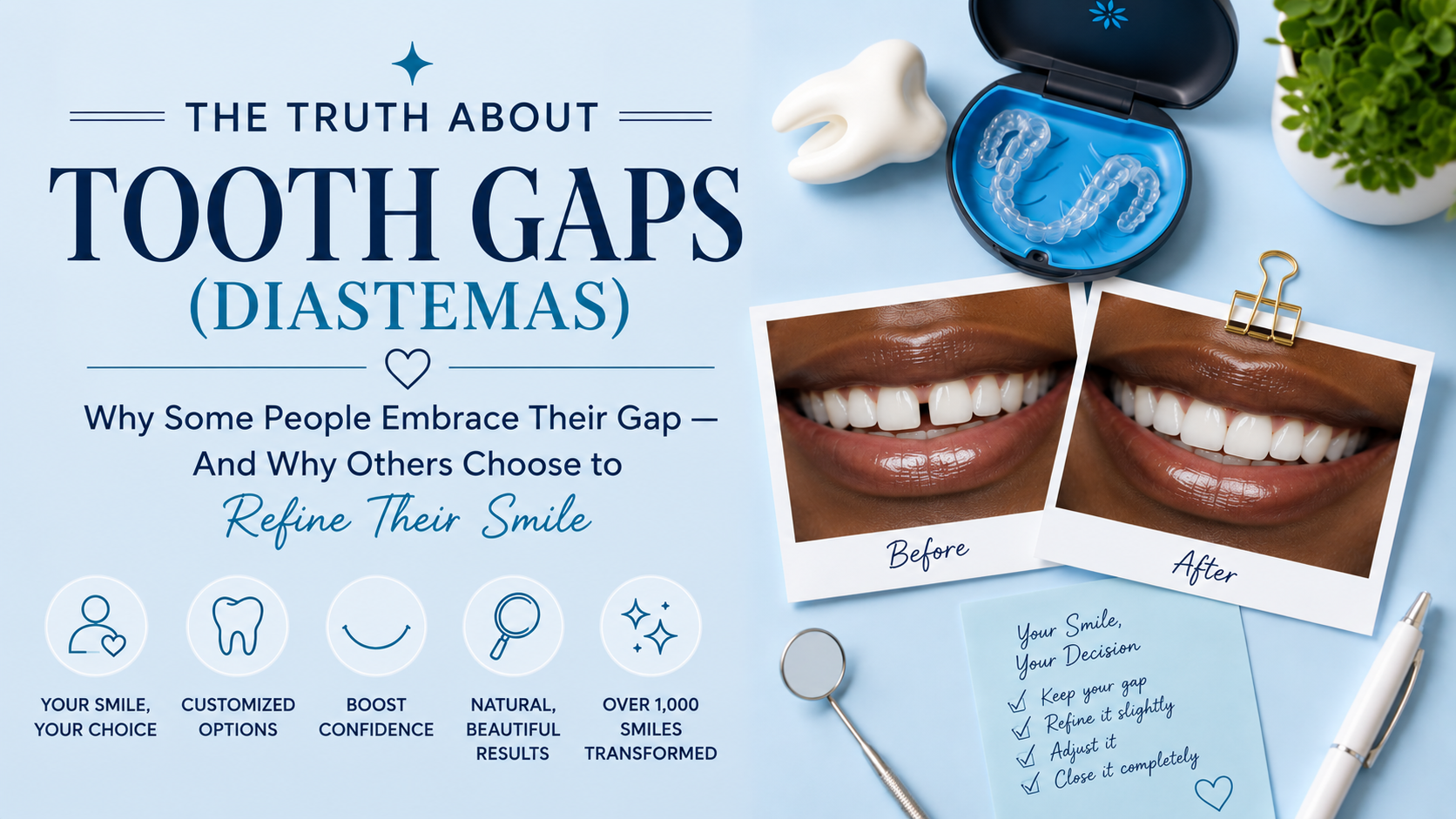
Tooth gaps — known in dentistry as diastemas — are far more common than many people think.
For some people, a gap between the teeth becomes part of their identity. It’s a signature feature that makes their smile unique and recognizable.
For others, it’s something they notice every single day.
It may be the reason they hesitate to smile in photos, feel self-conscious during conversations, avoid showing their teeth on Zoom calls, or become hyper-aware of their smile in professional settings.
But here’s the most important thing to understand:
You are in control of your smile.
Modern cosmetic dentistry allows patients to customize the appearance of their tooth gap based on what feels most comfortable and authentic to them.
Whether you want to:
the decision is entirely yours.
A diastema is simply a space or gap between two teeth, most commonly the upper front teeth.
Gaps can happen for several reasons, including:
In many cases, tooth gaps are completely healthy and do not necessarily indicate a dental problem.
For some patients, the gap becomes a defining aesthetic feature of their smile.
One of the biggest misconceptions about cosmetic dentistry is that every smile needs to look identical.
That’s not true.
Smile design today is highly personalized.
Some patients want:
Others want something more natural and subtle.
That’s why many dentists now approach smile makeovers with customization in mind.
As the transcript explains:
“It’s not just a gap — it’s a smile design feature.”
And that changes the conversation entirely.
One of the most interesting things about modern smile design is that tooth gaps can be adjusted at different levels.
Patients may choose:
In other words, you don’t have to completely eliminate the space if you don’t want to.
Some people prefer maintaining a small amount of spacing because it preserves the character of their smile while still improving symmetry and confidence.
Others may want a dramatic transformation.
Both approaches are valid.
For many people, the emotional impact of a tooth gap has less to do with health and more to do with confidence.
Research consistently shows that people associate smiles with:
A person who feels insecure about their smile may:
That’s why cosmetic dentistry often goes beyond aesthetics.
For many patients, improving their smile can positively affect:
Today’s cosmetic dental treatments are more customizable than ever before.
Depending on the size and structure of the gap, treatment options may include:
The goal is not simply creating a “perfect” smile.
The goal is creating a smile that feels natural to you.
One of the most powerful shifts happening in cosmetic dentistry is personalization.
Not every patient wants the exact same smile.
Some patients love their tooth gap and simply want minor refinements.
Others are ready for a complete transformation.
The important thing is that you have the power to decide what works for your face, your personality, your lifestyle, and your confidence.
Every smile tells a different story.
Over the years, dental professionals across Trinidad & Tobago have helped thousands of patients improve their confidence through customized smile transformations.
And sometimes, the smallest adjustment can make the biggest difference.
A subtle refinement.
A more balanced smile.
A gap adjusted just enough to help someone feel comfortable smiling again.
Whether you view your tooth gap as a signature feature or something you’ve always wanted to change, modern dentistry gives you the flexibility to choose what feels right for you.
Because at the end of the day:
your smile should feel like your own.


.svg)